
On the Ides of Feb, namely February 14th, there was an old pagan forerunner to Valentines Day! Of course this has nothing to do with Valentine’s Day, we are told. No, that comes from Saint Valentine, a Christian martyr who defied Emperor Claudius II by marrying star-crossed lovers in secret. Yeah sure, when you can’t take away a popular festival of love from the people, and why would you want to? Then you have to find a way to make it part of your own Christian Practice, right? Thank the old Gods that light is finally being shed on how these older pagan festivals were stolen and incorporated into Christianity. Not to be bitter but yay to that!
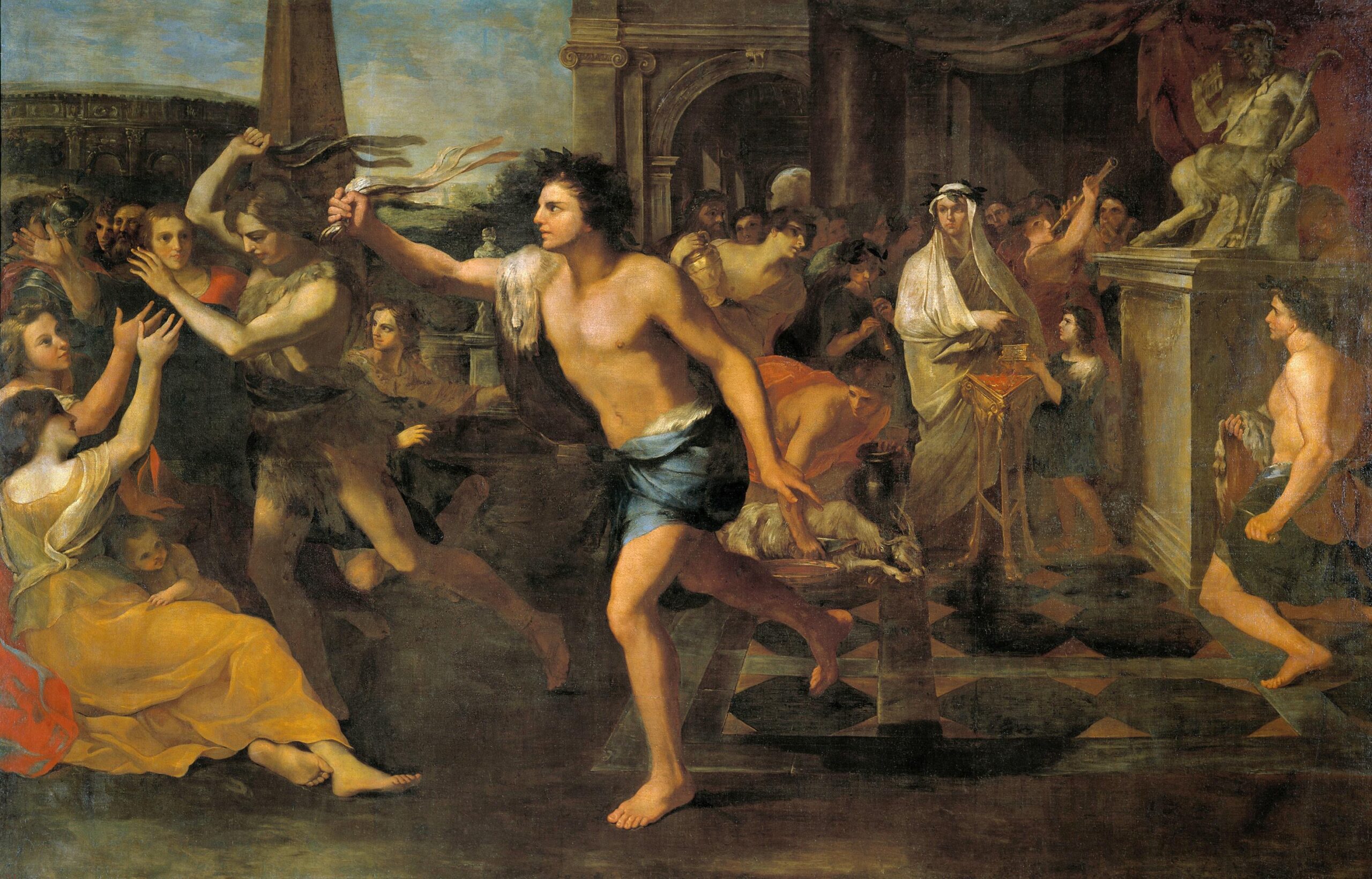
Thankfully most pagans today do not buy into the St Valentine story! So guys, chuck out your whimsy cards and flowers and bring on the floggers baby! LUPERCALIA! So then, what was or is the Lupercalia? Well, it was a Roman Festival of cleansing & fertility – two themes that may seem odd to be put together in today’s world. But as we delve deeper this will make sense. The Lupercalia was made in honour partly to Lupercus, the Roman name for Pan, and partly to the She Wolf Lupa, who suckled the twins Romulus and Remus.
Abandoned by Mars, these twins Romulus and Remus were suckled by the She Mother Wolf Lupa. Later Romulus was to slay his twin and founded Rome on Palatine Hill upon his bones beneath the first wall, often displayed in the Sun card. This mythos depicts the mystery of how sacrifice makes Sacred through destruction and rebirth, the destruction of a life in one form to re-birth into another more evolved, Sacred & Divine. This particular mythos of destruction and rebirth into divinity is also reflected in the Greek story of Twins, Castor and Pollux. And it’s here, with the original Greek legacy, that we get some clarity on the cleansing aspect of the Lupercalia.
Before the Lupercalia, within the Greek period, there was an older version of this celebration, called the Lykaia, where men would engage in what was basically shapeshifting of a sort. The first recorded form of shapeshifting is that of werewolves. In a world where wolves were rightly feared by anyone sick and/or left to fend for themselves, they became the avatar for the prime predator that would cull the herd of humanity of its weakness. This culling can be seen as a purging. In today’s society we would not entertain this, but back in those times the survival of the tribe superseded the needs of the weak or infirm. This Wolf totem association with culling the Tribal Herd has presented itself in violent and perverted ways throughout history, not least as a totem of the Nazis in the second world war.
In the Lykaia, naked men draped in wolf skins would engage in a bacchanal together with female maenads. And if you think maenads are sexy, think again! These maenad women were followers of Dionysus, and they were fierce and wild as unleashed nature could ever be! Put them together with Male followers, clad in wolf skins becoming wolves, and it should be no surprise that these celebrations devolved into actual cannibalism, beyond swallowing! And all of this was a celebration in honour of Pan, the Horned God of primal nature, himself!
This combination of a sexual bacchanal mixed with purging of the weak, as a tribal cleansing, was incorporated into Roman practice in the form of whipping and lashing of men and women, to cleanse them, while also cleansing the city, all which led up to festival orgies in the Temples. This cleansing and fertility event strengthened the herd, by temporarily removing the tightly controlled, civilized restrictions of a militarized society, while allowing for the purging of inner feelings of violence and unbridled passion. This festival of lust was seen as supportive to growing the herd and exposing the weaknesses.
The Festival of the Lupercalia, like the Lykaia, may be a far reach for our society today. But by understanding its goals, and not sitting in harsh judgement over it, we may capture the deeper spirit of this ancient pagan legacy and find new ways to celebrate and integrate it back into our modern pagan practices and observances. Perhaps one aspect to look at could be: to cleanse ourselves of lust, not just sexual lust, but the lust for revenge, ownership, self-importance, all forms of obsessive desire that finally serves only to undermine us. To address this, either we permit ourselves to indulge in some safe manner in order to get it out of our system. Or we indulge in some form of the Hieros Gamos, to sacrifice our self-identity and self importance, our desires and wants, into the embrace and trust of another, through an act of Love.
This then brings us back to Valentine’s Day. But offers us perhaps a deeper exploration of Love. Not just the token offering of cards and flowers. Of course you can still play with the floggers, but another way to add the purging part of the Lupercalia into the Love part, is to purge what may still divide you from a loved one. To make the relationship into something Sacred, something that lifts you and your loved ones into place of joy and liberty, freed from the remnants of broken moments, lingering unresolved from the past. Those things that no longer serve today.
So if you happen to find yourself physically alone this Valentines Day, how about a date night with a God? Prepare yourself and your love den for an evening of unconditional Love, and invite a God, or Goddess to come join you in a euphoric Ritual of Love. I’d probably choose a night with Aphrodite or Dionysus or some God like that. Not sure a date night with Baba Yaga, Black Anis, Hades, Charon or the Cailleach, would deliver good results.
But whether you are alone or looking for a transcendent evening with a loved one, consider asking a God to join you. After all, we are Pagan, and pagans are Polytheistic, and you know what that means (wink).
