
“I’m a magical tool maker.”
That’s what I say when people ask me what I do, usually in conversations about hobbies or crafts. It tends to stop things for a moment. My muggle friends or coworkers look at me like I’ve grown a second head. Sometimes they laugh, sometimes they nod politely, unsure whether I’m joking. I’ll show them pictures of rune sets and wands, and almost without fail the conversation quietly changes direction. Another topic appears, safer and easier to hold.
I don’t mind. Not really. Some things don’t translate well unless you’ve felt them yourself.
I am a magical tool maker. I work primarily with wood because of how it feels—both in my hands and in my attention. I like everything about it, especially the act of finding the wood to begin with. The searching matters. I’ve sourced wood from parks, creek sides, and cemeteries. People ask me to gather it from their yards, and I love that. Snow‑felled trees, lightning‑struck trees, trimmed trees, hedges—all woods are welcome. Each carries its own history, its own pace, its own very individual core spirit.
Finding the wood is never just scavenging. It’s noticing. It’s paying attention to what’s been broken, cut back, discarded, or offered. I don’t take living trees. I take what’s fallen, what’s been released. Wood that’s already begun its next story.
Some woods are easier to work with than others, but that ease isn’t always about physical hardness. If it were, oak, ash, and thorn—white and black—would be a real drag to work with. Anyone who’s tried to carve them knows better. Difficulty has more to do with temperament than density. Some pieces resist every cut. Others open themselves willingly, almost gratefully. You can feel the difference long before you understand it.
Anyway, I’m a magical tool maker, and when I work with wood, my favorite thing to make is the wand. There’s a reason people say “the wand chooses,” and it has everything to do with Spirit—the spirit of the wood and the spirit of the seeker. A wand isn’t just shaped; it’s recognized. It’s not a tool you impose yourself upon the world with. It’s a relationship you agree to carry.
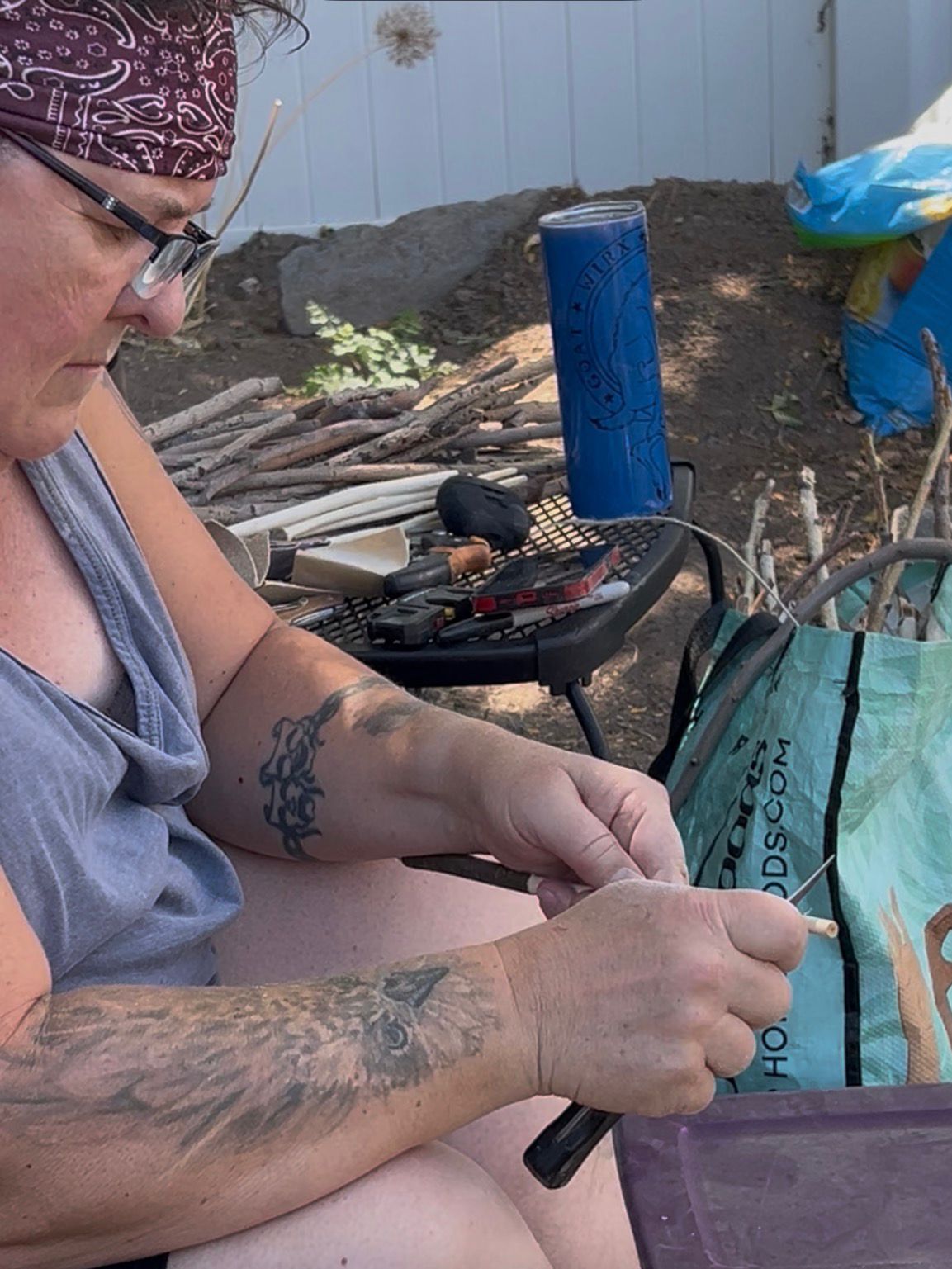
I work in my backyard, in the southeast corner, shaded by a huge pine tree. That detail matters to me. Place always does. I’ll have a pile of raw sticks, a table with pruners, a pocketknife, and a stack of different‑grit sandpaper. Nothing fancy. Nothing loud. The work doesn’t ask for much, but it does ask for presence.
The process itself is simple and not simple at all. Peeling bark. Sanding roughness down. Shaping what wants to be held. But the biggest and most important part of the work is getting out of my own way. That means slowing down. That means listening. Feeling the grain under my fingers. Paying attention to resistance. Talking to the wood, if you will—not in words, exactly, but in awareness. Meditating on the Spirit of the piece as it reveals itself.
This isn’t about forcing the wood into an idea I had before I picked it up. It’s about meeting what’s already there. When I rush, the work goes poorly. When I try to dominate the shape, the wand becomes dead in my hands. But when I listen—when I let effort and patience find their balance—something else happens. The piece begins to tell me what it wants to be.
In the end, it’s no longer just willow or hazel. It’s a Willow Wand. A Hazel Wand. Something named. Something ready.
This is why I keep coming back to the work. Not to make objects, but to practice listening. To practice getting out of my own way. To sit beneath a pine tree with a knife and sandpaper and let the wood speak in its own time. The finished piece matters, but the practice matters more. Each wand teaches me how to pay better attention the next time.
I am a magical tool maker. I work with wood, with patience, and with Spirit. I listen more than I force, and I trust the process more than the outcome. What leaves my hands is not just shaped—it is met, named, and ready.
